The Impact of Our Report Policies and Patterns


When HRC published Policies and Patterns: State-Abetted Transnational Crime in Cambodia as a Global Security Threat in May 2025, we knew the report would be difficult to ignore.
It examined how trafficking-fuelled cyber-scam operations in Cambodia were not simply the work of isolated criminal actors, but part of a wider political, financial, and institutional ecosystem. The report drew on extensive research, including 51 interviews with survivors, practitioners, journalists, and experts, and set out a framework for understanding how these crimes were enabled, protected, and sustained.
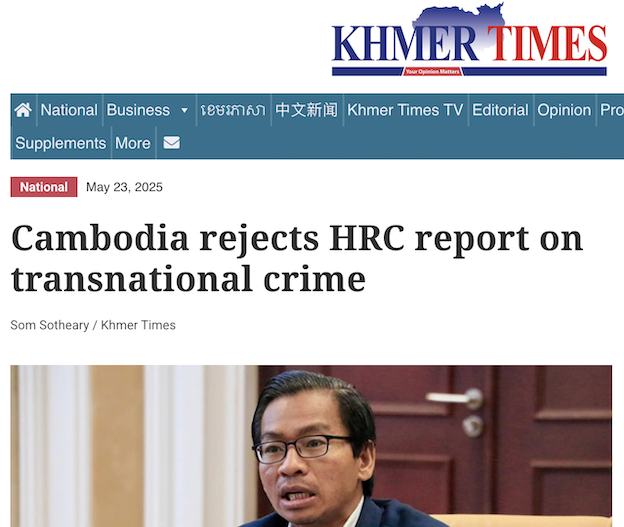
The response was immediate. Prince Holding Group publicly rejected the report. Cambodian government also dismissed its findings. For a time, the report was attacked as inaccurate, political, and unfair.
Both HRC and the report's author, Jacob Sims, received multiple threats and legal challenges demanding the report's removal. We chose to stand by the research. In retrospect, we are grateful we did.
The report's title, Policies and Patterns, was drawn from the 2019 amendment to the U.S. Trafficking Victims Protection Act, which requires the identification of countries where there is a “government policy or pattern” of human trafficking. One of the report’s central findings was that the evidence from Cambodia met that threshold. Appendix A set out the first publicly articulated typology of evidenced government support for trafficking into scam compounds, documenting how state-linked protection, elite impunity, official inaction, and political-financial incentives allowed the system to endure.
In October 2025, the U.S. Trafficking in Persons Report named Cambodia, for the first time, as a state sponsor of trafficking under that policy-or-pattern framework. The designation confirmed that the concerns raised in Policies and Patterns were not only credible, but had become central to how the U.S. government understood Cambodia’s role in the regional scam-compound economy.
Months later, Policies and Patterns appeared as the only externally cited source cited by the U.S. Department of Justice in a civil asset forfeiture action involving approximately USD 15 billion in assets linked to scam-compound activity. The filing, described as the largest criminal asset forfeiture action in U.S. history, cited HRC’s research in explaining the scale and structure of the regional scam economy.
The report also helped shape wider policy discussions. It publicly recommended, for the first time, 28 individuals to be sanctioned for transnational accountability measures. The list was later incorporated into bipartisan legislation introduced in the U.S. Congress. Since publication, 14 of those individuals have been sanctioned or indicted by governments including the US, UK, China, Singapore, Korea, and Japan.

The report was never just about naming criminals. It was about documenting a system that survivors, journalists, and frontline responders had been warning about for years, often at great personal risk.
Since its publication, the report has featured in more than 100 media engagements. The fact that this work has gone on to influence legislation, sanctions, law enforcement actions, and public debate demonstrates the value of independent research.
At the same time, Policies and Patterns was intended not only as an investigation into Cambodia, but also as a framework for understanding scam economies more broadly.
Its analysis of the relationship between criminal capital, human trafficking, money laundering, permissive governance, and elite protection can be applied across Southeast Asia and other scam-hosting contexts. Likewise, its taxonomy of kleptocratic mechanisms provides a foundation for future research into the architecture of scam states and helps identify more precise intervention points for sanctions and financial disruption.